
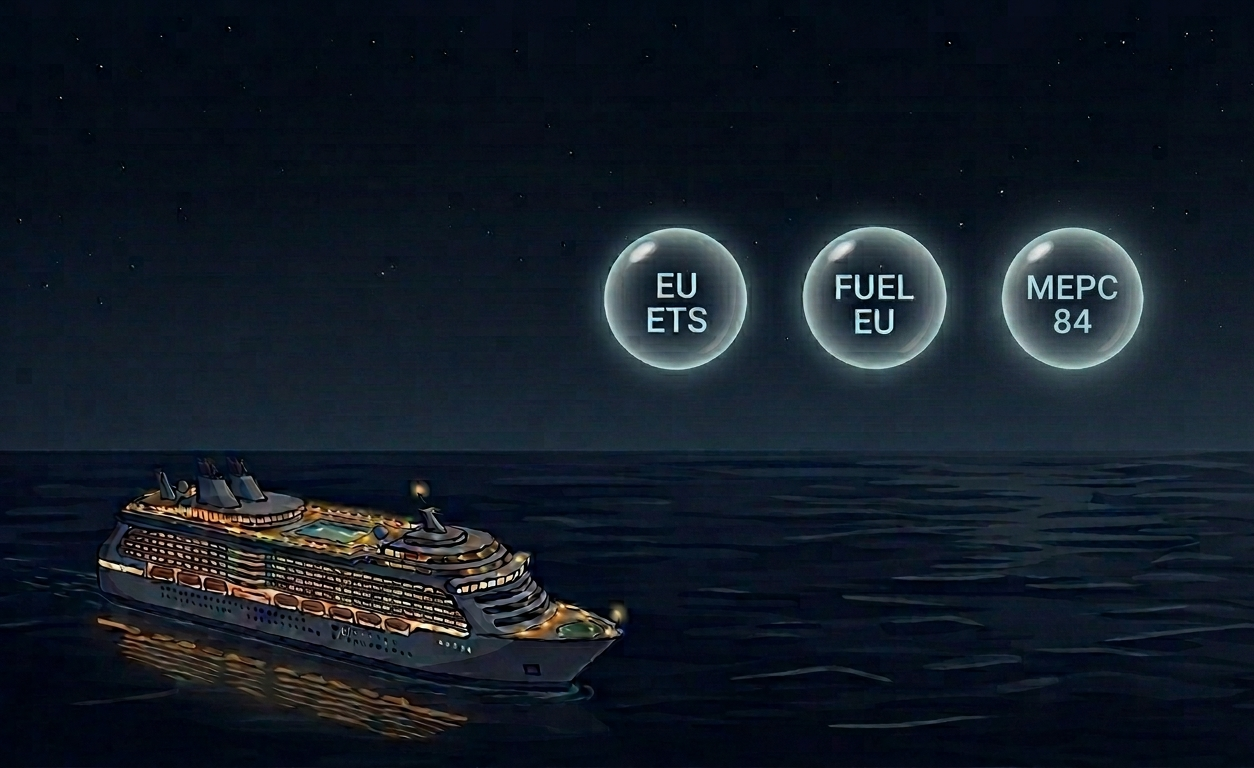
Liquefied Natural Gas (LNG) remains the most scalable, proven alternative fuel currently powering modern, large-capacity passenger vessels. As regulatory frameworks under FuelEU Maritime and the EU ETS mature, emissions management is expanding into a more precise, holistic model.
For cruise operators, this shift represents a clear opportunity to demonstrate proactive fleet management by optimizing combustion efficiency and taking advantage of emerging efficiency technologies. Cruise ships and ferries run on 4-stroke medium-speed Otto-cycle engines. For these engines the FuelEU standard default slip factor is 3.1%. But in many cases, cruise lines can come way below the standard value. Here we tell you how:
Engine load monitoring (ELM): The cost benefit depends on the engine and the operating profile
According to IMO Resolution MEPC.415(84) Engine Load Monitoring (ELM) lets operators replace the conservative default with verified, vessel-specific data — a real opportunity to lower reported GHG intensity and the FuelEU and ETS costs that follow. But whether it pays off depends on the engine and on how the ship is actually run.
Factors such as operational profile, number of sea days, shore power days have influence on engine load profile and can thus improve or worsen a ships annual methane slip. One way to find out about the methane slip situation for a particular ship is simulation. When in doubt, if switching to ELM makes sense, ALFRED Maritime can model the relationships between methane slip and influencing variables and compute the potential costs for a given ship with simulation.
| Engine condition | Likely measured result | Implication |
|---|---|---|
| Modern, well-optimised dual-fuel | Often more than 50% below 3.1% default | Competitive advantage; lower cost |
| Older / poorly optimised | May come back above default | Pre-existing problem made visible |
ELM delivers accuracy, not automatically lower numbers — and reaching a verified figure is data-intensive. The actual slip factor is not a single reading. Engine load is logged continuously (MEPC requires a recording frequency of at least 0.0033 Hz — roughly every five minutes) and condensed into 30-minute averages. For each interval, the slip rate is interpolated from a measured slip-versus-load curve, multiplied by gas consumption, and summed across the full calendar year to give the annual factor. Done across several engines, with the traceability a verifier demands, this is not a spreadsheet exercise — it needs dedicated monitoring and calculation software.
ALFRED Maritime supports with software that constantly computes and forecasts ELM – based methane slip. The data can be provided within MEMS package or as a separate, standalone module called ELM Easy verify. In both cases, the software prepares the data such it is „verifier-ready“ and that verification can be done on a regular basis.
The methane slip FILE as input for ELM
The input for ELM is an initial measurement to generate the slip-versus-load curve – and that is highly regulated procedure. According to MEPC 84 a so-called methane slip file can be created from (simplified/not exclusive):
- One time measurement — the flame ionisation detector with non-methane cutter (FID+NMC) is the reference method, with validation rules for alternatives such as FTIR or NDIR.
- The 5 Load Points: Verified data points measured at specific Engine Maximum Continuous Rating (MCR) points: 10% (or the lowest load point where gas fuel can legally/physically be used), 25%, 50%, 75%, and 100%.
The load points are a direct input to ELM interpolation calculation. The final aim of the methane slip file is:
- Replace generic defaults with vessel-specific data via Engine Load Monitoring (ELM) — the basis for reporting real emissions instead of the conservative 3.1% FuelEU default.
Together with Meyer RE, we offer to prepare the measurement of methane slip file. The file then needs to be verified by a third party.
What operators should do now
| Step | Action |
|---|---|
| 1. Model exposure | Model your cost exposure under the baseline 3.1% default versus the ELM method. For ELM modeling, ALFRED Maritime provides consultancy and simulation services that account for your unique operational profiles. |
| 2. Conduct Measurement / Methane Slip File | Once the decision is made to pursue ELM, a methane slip file must be created by a certified measurement company. This file needs to be Class-approved, and the Flag State must be formally notified of your intent to use the ELM approach. |
| 3. Implement ELM | Capture real operational weighting with granularity, traceability and independent verification. Install a software e.g. MEMS or ELM Easy Verify, to constantly track methane slip based on engine load. |
| 4. Verify | Engage a certified third-party verifier for the mandatory yearly verification of the data to finalize your FuelEU and EU ETS reporting. |
Know the number first; then decide how to act on it.
Sources
- IMO — Resolution MEPC.402(83), Guidelines for test-bed and onboard measurements of methane (CH₄) and/or nitrous oxide (N₂O) emissions from marine diesel engines (MEPC 83, April 2025).
- IMO — Resolution MEPC.415(84), Guidelines for engine load monitoring (ELM) and calculation of emission values (MEPC 84, May 2026).
- IMO — Resolution MEPC.414(84), 2026 Guidelines for test-bed and onboard measurements of methane (CH₄) and/or nitrous oxide (N₂O) emissions from marine diesel engines (MEPC 84, April 2026)
- European Commission — Guidelines for reporting and verification of actual methane slip tank-to-wake emission factors under FuelEU Maritime (8 October 2025).
- Regulation (EU) 2023/1805 (FuelEU Maritime), Annex II default slip factors (Cslip); EC Q&A on Regulation (EU) 2023/1805 — transport.ec.europa.eu.
- DNV — EU guideline for reporting and verifying actual methane slip for FuelEU and EU MRV/ETS (Nov 2025) — dnv.com.
- Sustainable Ships — Emission properties for EU ETS, FuelEU and IMO (IMO 3.5% vs EU 3.1% Cslip for medium-speed Otto) — sustainable-ships.org.
- ICCT — The climate implications of using LNG as a marine fuel (engine-type prevalence on cruise ships) — theicct.org.
- Methane slip and other emissions from a newbuild LNG engine under real-world cruise-ship operation, ScienceDirect (2024) — load-dependent 4-stroke slip data.
Disclaimer: This article is provided for general information only and does not constitute legal, regulatory or technical advice. ALFRED Maritime GmbH accepts no liability for any errors or omissions, or for any action taken in reliance on the information contained herein.