
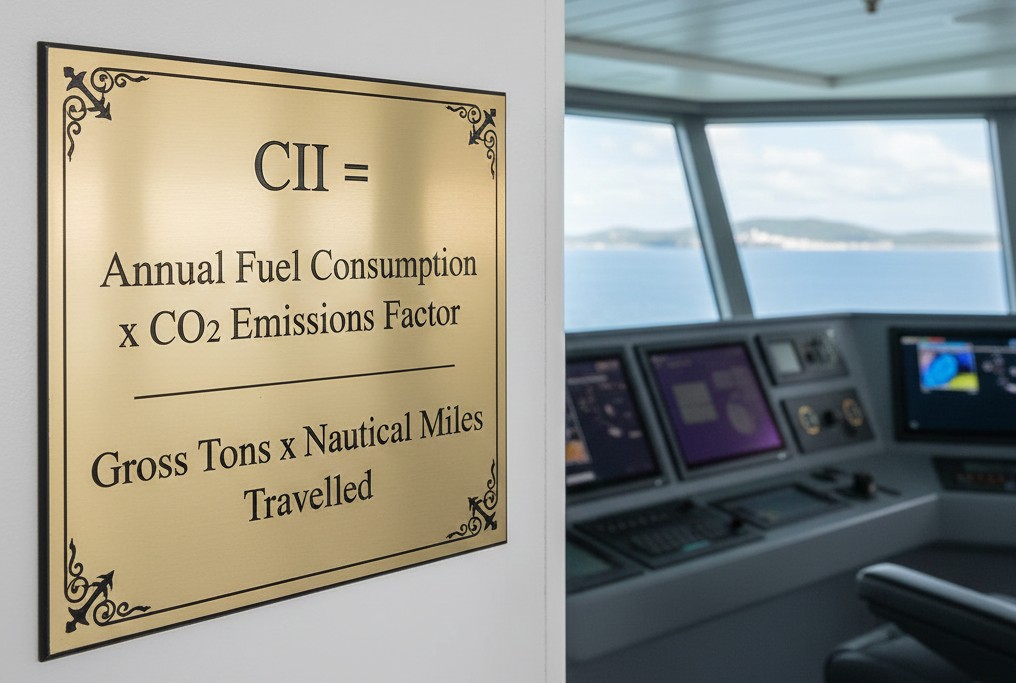
In the rapidly evolving maritime landscape, the cruise industry faces a unique set of challenges in its quest for sustainability. Central to this mission is the Carbon Intensity Indicator (CII), a regulatory benchmark introduced by the International Maritime Organization (IMO) to track and reduce vessel emissions. For cruise ships, achieving a favorable CII grade is not just about environmental prestige—it is a operational and commercial necessity.
At the heart of this transition is the MEYER Energy Management System (MEMS), the digital “brain” of the vessel that is proving to be a critical tool for navigating the complexities of CII compliance.
MEMS provides Monitoring and Predictive Analytics
The “keep track” aspect of Meyer EMS is one very vital regulatory function.
- Real-time CII Tracking: MEMS provides a “live” CII dashboard, showing the crew exactly where they stand against their annual target.
- Predictive Forecasting: By analyzing the current itinerary and weather forecasts, MEMS can predict the ship’s year-end rating. If the ship is trending toward a “D” or “E” rating, the system can suggest corrective actions—such as slightly decreasing speed on the next leg or reducing non-essential hotel loads—to pull the rating back into the “C” zone.
Besides the regulatory necessity for calculating CII, the intent of real-time tracking and prediction functionality in MEMS is to involve the crew onboard. Setting and keepting targets helps to motivate teams to run ships efficiently and reflect on operational routines.
Recap of CII in the Cruise Context
The Carbon Intensity Indicator (CII) measures how efficiently a vessel transports its cargo or passengers. Expressed in grams of CO2 emitted per gross tonnage (GT) and nautical mile, it results in an annual rating from A (Major Superior) to E (Inferior).
CII= Annual CO2 Emissions / Gross Tonnage × Distance Sailed
For cruise ships, the CII formula presents a “conundrum.” Unlike cargo ships, where the primary energy drain is propulsion, cruise vessels are “floating cities.” They possess massive hotel loads—energy required for HVAC, lighting, water desalination, and entertainment—that remain high even when the ship is stationary or moving slowly.
While for the ship types LNG carriers, tankers and ice-classed ships the so-called “correction factors” might be used, usually for passenger ships (cruise vessels, ferries, ro-ro ferries) correction factors cannot be applied. Therefore, correction factors can be kept out of the formula within this context.
Particularities of Energy Consumption for Cruise and Ferry Vessels
- The Hotel Load Factor: In many passenger vessels, the hotel load can account for 40% or more of total energy consumption. Since the CII formula penalizes CO2 emitted while the vessel is at berth (where distance equals zero), these ships are naturally at a disadvantage.
- Operational Profiles: Cruise ships spend significant time in port or maneuvering at low speeds, both of which negatively impact the “distance” variable in the CII equation, often leading to a higher (worse) rating despite lower total emissions compared to high-speed transit.
Conclusion
For the cruise industry, the CII is a moving target that becomes progressively stricter every year. Relying on manual adjustments and traditional engineering practices is no longer sufficient to remain compliant. Our MEYER Energy Management System transforms the challenge of CII from a regulatory burden into an optimization opportunity. By intelligently managing the unique hotel loads of cruise vessels and providing real-time visibility into carbon intensity, MEMS ensures that ships not only sail more sustainably but also protect their commercial viability in a decarbonizing world.